My Portfolio
This site—Next.js, Contentlayer, Redis view counts, and an AI-native delivery loop: Cursor agents, RAG over my CV for the Experience page, Figma MCP for pixel-faithful UI, and Google Stitch to draft layouts before refinement in Figma.
Flows & screens
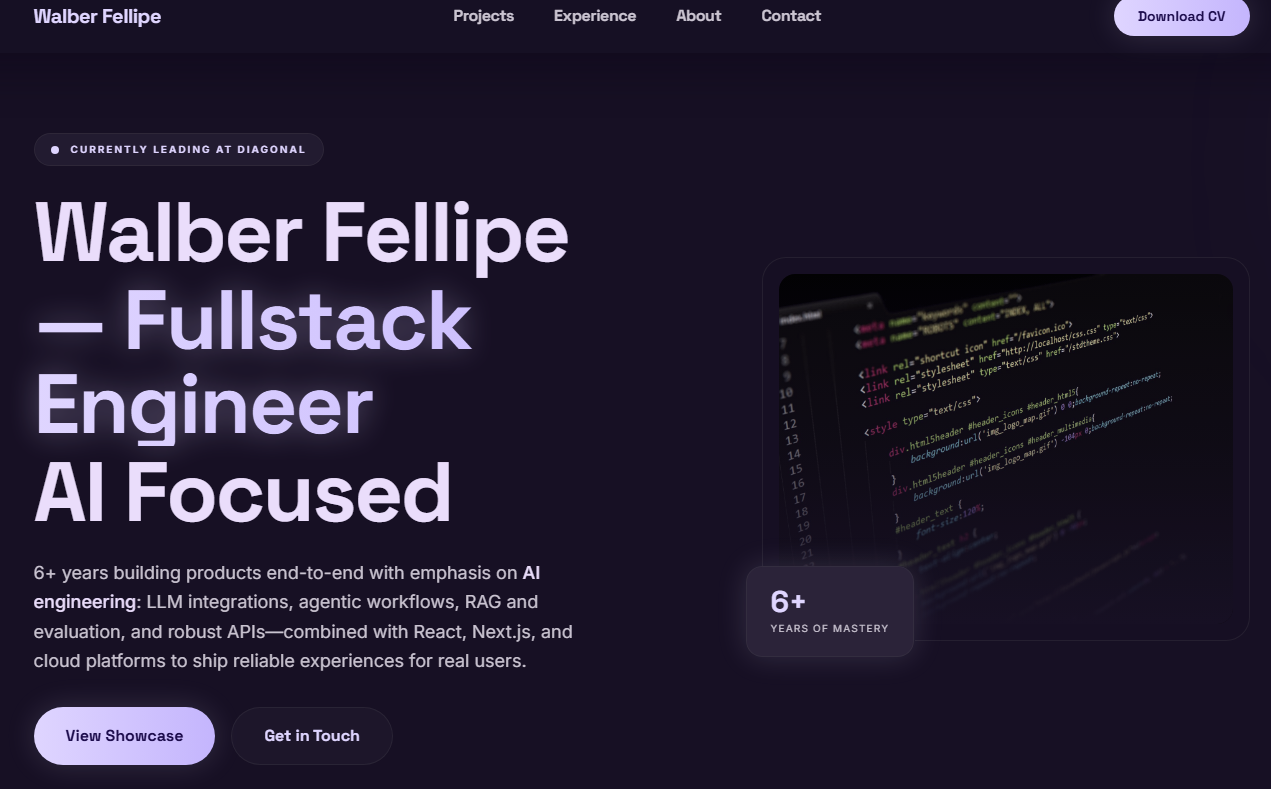
01 Home hero: AI-focused positioning, code visual, and navigation aligned to the Figma portfolio spec.
Implementation
Design fidelity
Layouts and components traced from Figma via MCP-driven workflows, then tuned in code for accessibility and performance.
Content pipeline
Project pages authored in MDX with typed frontmatter; build-time generation via Contentlayer.
Engagement signals
Serverless-friendly Redis counters for project views, wired to detail pages without blocking static content where possible.
Description
This portfolio is a refactored Next.js codebase deployed on Vercel: navigation, /projects, /experience, case-study shells, and theming were rebuilt around a Figma-first spec, not an inherited template story. Projects are listed from Contentlayer-backed MDX, and a small REST integration with Upstash Redis powers page view counts on case studies.
Delivery leaned on an AI-native loop grounded in real artifacts: Cursor (including agent-style sessions) for implementation; retrieval over my CV (RAG) so the Experience page tracks what I actually shipped; Figma MCP so frames could be read and mirrored in code instead of approximating layouts; Google Stitch to generate first-pass page ideas that were then refined in Figma before landing here; and Cursor Composer / agent for large, coordinated edits across the repo.
Roadmap
I still iterate here when time allows—more case studies, tighter visuals, and small DX wins on the MDX + deploy pipeline.